Nigeria Tech Update: What AI, Cybersecurity and Digital Skills Developments Mean for You
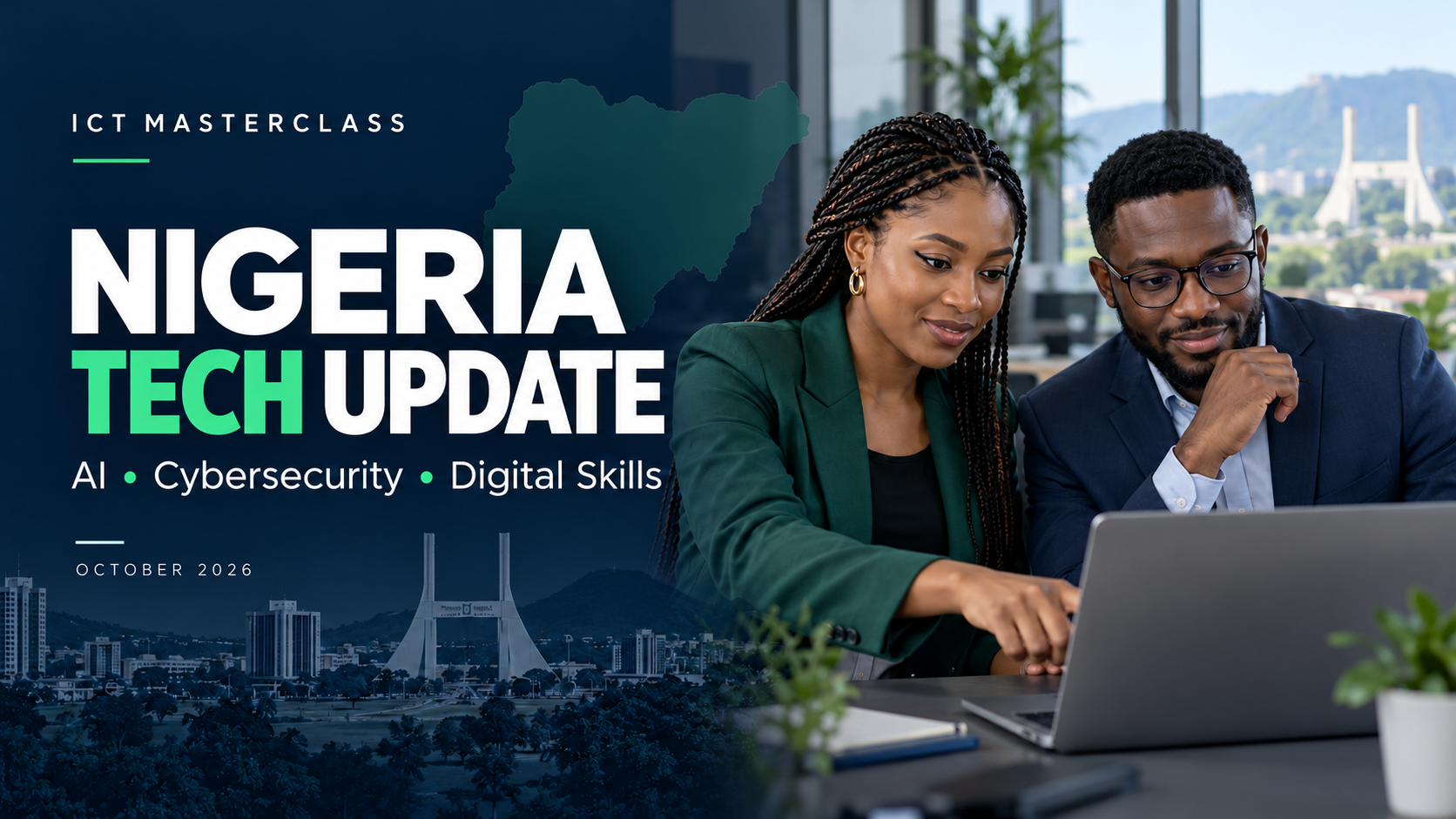
AI tools, cloud services and digital platforms are changing how organisations work. For Nigerian businesses and professionals, the challenge is deciding which developments deserve attention—and how to apply them safely.
This edition brings together recent announcements and earlier initiatives that remain relevant in October. It explains what has been announced, what still needs verification and the practical lessons for your business or career.
1. AI Agents Need Supervision Before They Get Access to Business Systems
On 19 October, Microsoft outlined an expanded approach to securing AI agents operating inside organisations. Its Project Perception approach brings together agent discovery, identities, permissions, risk assessment and controls intended to contain unsafe actions.
An AI agent can do more than generate text. Depending on its configuration, it may access documents, use applications or take actions within a workflow. That makes its permissions an important part of deployment.
For example, an assistant helping prepare payment requests may need access to selected invoices. Giving it unrestricted access to company files or authority to approve payments would create a much broader risk.
The practical lesson: Before connecting AI to business systems, define:
The task it is allowed to perform.
The information it can access.
The actions that require human approval.
The person responsible for reviewing its work.
How its access can be withdrawn.
ICT Masterclass perspective: AI training should teach staff how to verify results and protect information alongside writing effective prompts. Microsoft’s announcement also should not be interpreted as confirmation that every new control is available in every Microsoft 365 subscription.
2. Cybersecurity Awareness Must Cover Voice Cloning and Deepfake Impersonation
October’s cybersecurity awareness campaign provides a useful opportunity to review everyday digital habits.
According to TechAfrica News’s report on NITDA’s campaign, the agency highlighted AI-driven social engineering, voice cloning, deepfake impersonation and fraudulent QR codes. It also encouraged stronger passwords, multi-factor authentication, software updates and careful handling of sensitive information on AI platforms.
These warnings have practical implications for workplaces.
Consider a fictional example: an accounts officer receives a voice message that sounds like the managing director, requesting an urgent transfer to a new account. Recognising the voice should not replace the organisation’s normal payment verification process.
The same principle applies to messages requesting passwords, confidential documents or changes to supplier bank details.
What to do now:
Verify unusual requests through an established contact channel.
Require a second approval for sensitive financial changes.
Enable multi-factor authentication on important accounts.
Give staff a clear way to report suspicious messages.
Use short, realistic exercises to reinforce awareness.
ICT Masterclass perspective: Effective awareness training should help employees practise decisions they may face at work. A presentation becomes more useful when participants can recognise a suspicious request and explain their next step.
3. Digital Training Opportunities Are Expanding—Choose a Clear Learning Path
Nigeria’s Digital Training Academy portal advertises government-sponsored learning in areas including cloud computing, cybersecurity, IT automation and AI. The portal currently states that the initiative offers 32,000 learning licences and describes registration, learner profiling and an assessment process. Current eligibility and availability should be checked directly with the programme.
For learners, access to more courses creates an important decision: what should you study first?
Start with the work you want to do.
Someone interested in IT support could focus on operating systems, networking, Microsoft 365 administration and troubleshooting. A business professional may benefit more immediately from spreadsheets, reporting, AI productivity and digital security. An aspiring developer needs a foundation in programming, version control, databases and deployment.
A practical learning approach:
Choose one role or business problem.
Identify the foundational skills it requires.
Complete a relevant course.
Build a small project that demonstrates the skill.
Document what you built and what you learned.
ICT Masterclass perspective: Certificates can support a professional profile, but practical work gives learners something concrete to demonstrate. Training providers can add value through guided projects, feedback and support applying new skills.
4. SME Digital Transformation Should Begin With Everyday Business Problems
NITDA and NACCIMA have announced a partnership covering MSME digital transformation, technology adoption and business capacity building. The agreement establishes areas for cooperation; it does not, by itself, demonstrate improvements in participating businesses.
For a small business, digital transformation can start with a familiar problem:
Customers wait too long for replies.
Sales and expenses are recorded inconsistently.
Stock figures are unreliable.
Outstanding payments are difficult to track.
Business records sit on one person’s phone.
A useful first project connects a few steps in a real workflow. For example:
Customer enquiry → order record → payment confirmation → receipt → stock update → follow-up.
The right tools depend on the business. The goal is to make the process easier to manage and measure.
ICT Masterclass perspective: Before buying software, identify the problem, assign someone to manage the process and decide how success will be measured. Useful measures might include fewer missing orders, faster responses or more accurate stock records.
5. Nigeria’s Cloud Policy Does Not Mean Every Business Must Host All Data Locally
Nigeria’s National Digital Cloud Policy, announced on 17 August, promotes cloud investment, government adoption and safeguards for defined categories of government and regulated data.
The ministry explicitly states that the policy does not impose general data localisation requirements on commercial data. This distinction matters when organisations assess hosting proposals.
Businesses should still understand where their information is stored, who can access it and how it can be recovered. Applicable requirements will depend on the data, sector and contractual obligations involved.
Before choosing a provider, ask:
Where will our data and backups be stored?
Who has administrative access?
What happens if the service becomes unavailable?
How do we retrieve our information when leaving?
What security and support responsibilities remain with us?
ICT Masterclass perspective: Cloud literacy belongs in management training as well as technical training. Business leaders need enough understanding to evaluate cost, access, continuity and provider commitments.
6. Microsoft’s Sovereign Cloud Announcement Highlights the Importance of Control
On 20 October, Microsoft announced an expansion of its sovereign cloud portfolio across public cloud, private cloud and partner solutions. Its stated focus includes greater control over sensitive workloads, operational access and technology dependencies. This is an international announcement, rather than confirmation of a Nigeria-specific launch.
For Nigerian organisations, the broader lesson is to look beyond the physical location of a server. Control also involves who operates the system, who holds access rights and how essential services continue during disruption.
ICT Masterclass perspective: Organisations considering specialised cloud arrangements should first define their requirements. Product availability, deployment scope and contractual commitments need verification before a purchasing decision.
7. Nigerian-Language AI Creates Opportunities That Need Careful Testing
NCAIR’s National AI Innovation Challenge promotes applications built with N-ATLAS, including local-language and voice-driven services. Its published application deadline was 12 October 2026; an extension should be verified before treating applications as open.
Potential applications include multilingual customer enquiries, educational support and information services. These are opportunities to investigate, rather than proof that a particular application is ready for deployment.
A useful pilot should test representative language samples, accents and questions. It should also measure incorrect answers and provide a clear route to human assistance.
ICT Masterclass perspective: Begin with a narrow task where errors can be identified and corrected. Applications involving health, legal or financial information require particular care in reviewing outputs.
8. Discounted SME Tools Still Need a Business Case
Paystack’s Small Business Programme introduced discounts across services including commerce, bookkeeping, logistics, design and customer communication. The programme was announced in June; current eligibility and offer availability need checking.
A discount can reduce the initial cost of adopting software. Businesses should also consider renewal prices, staff training, integration and the ability to export their records.
Before subscribing, ask whether the tool solves a current problem and whether someone will use it consistently. Several overlapping subscriptions can become an expense without improving the way the business operates.
ICT Masterclass perspective: Evaluate software using a complete workflow and realistic operating costs. Advertised discounts should also be understood as discounts, rather than cash grants.
Where Should You Start?
Choose one improvement you can complete and measure this month.
For an employer, that might be a staff session on safe AI use followed by a review of account permissions. For an SME, it could be organizing orders and payment records. For a learner, it could be completing a focused course and building one practical project.
Technology becomes valuable when people understand how to use it, recognize its limitations and apply it to a clear need.
Build Practical Digital Skills With ICT Masterclass
ICT Masterclass helps professionals, businesses and organizations develop practical skills in AI productivity, Microsoft 365, cybersecurity awareness and digital tools.
Looking for a workshop tailored to your team’s daily work? Visit ICT Masterclass to explore training options and discuss your organisation’s needs.
You may also like
Comments
No comment yet